Money Talks e-Newsletter | October 2025 |
|
|
|
|
Happy October, we are flying fast to the end of the year, and we have roughly 12 weeks remaining in 2025, so make it count. |
|
|
|
The importance of diversification |
|
|
I recently attended a conference on investing, and the key takeaway again was how vital diversification is in the investment space. Concentration is particularly beneficial for outperforming in specific cycles; however, diversified investments tend to outperform in the long run. Below is a chart illustrating the concentration of the SA market over the past 12 months, with Gold shares driving the JSE higher. |
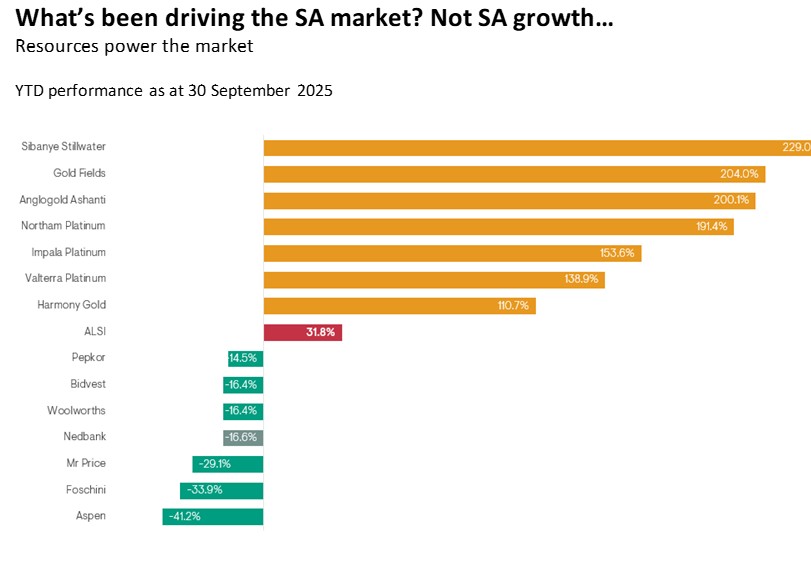 | From the chart above, it is clear that diversification is key, and chasing performance in the short term may work for a while, but in the long run, you may have a terrible time. |
|
|
| |
How income tax works in SA |
|
|
Every year, SARS updates the income tax brackets – those thresholds that determine how much tax you pay as your income rises. But here’s where many South Africans get it wrong: moving into a higher tax bracket doesn’t mean all your income is taxed at that higher rate.
Think of it like climbing stairs – only the next “step” of income is taxed more, not the whole staircase. |
|
|
For example:
If you earn R350,000 per year, you may fall into the 26% bracket. However, only the portion of your income exceeding R237,100 is taxed at a rate of 26%. Everything below that still enjoys the lower rates. |
|
| |
So where’s the danger? Bracket creep.
When your income increases slightly (perhaps from an annual raise or investment income) but the tax brackets don’t move enough to keep up with inflation, you could end up paying a higher effective tax rate even though your real buying power hasn’t changed. How to stay ahead of bracket creep:
Maximise your deductions: Contributions to your retirement annuity (RA), medical aid, and certain investment costs can reduce your taxable income. Use tax-free investments (TFSA): Growth and withdrawals are completely tax-free – great for medium- to long-term goals. Time bonuses and withdrawals wisely: If you can, spread them across tax years to avoid pushing your annual income higher than needed. Review your financial plan annually: Small adjustments can make a big difference to your after-tax income over time. In short, tax brackets aren’t something to fear, but something to understand. The smarter you are about how your income is structured, the more of it you get to keep. |
|
| |
Please let me know if you would like to schedule a meeting and review your portfolio. |
|
|
|
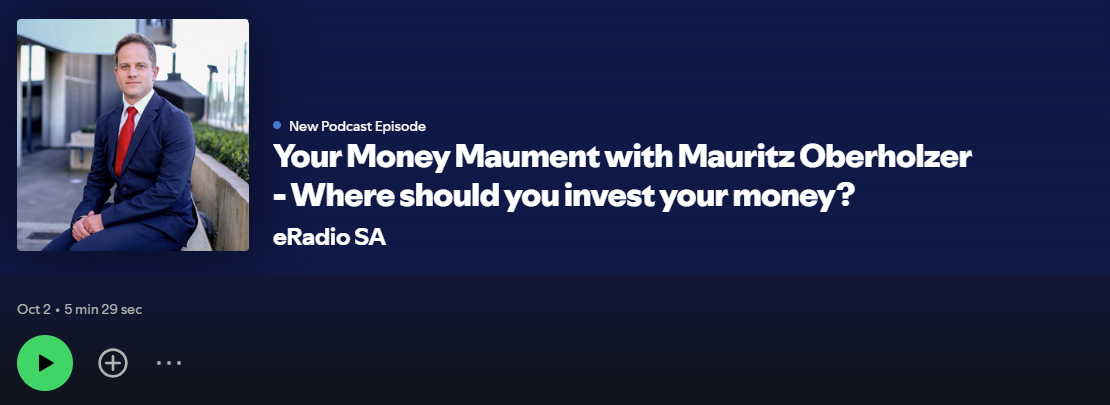
Here is my most recent podcast show you can listen to: |
 |
|
| |
|
|
|
Disclaimer: The information transmitted by this e-mail is intended only for the person or entity to which it is addressed. This e-mail may contain proprietary, business-confidential, and/or privileged material. If you are not the intended recipient of this message, be aware that any use, review, retransmission, distribution, reproduction or any action taken in reliance upon this message is strictly prohibited. If you received this in error, please contact the sender and delete the material from all computers.
|
|
Contact:
Mauritz Oberholzer A Financial Advisor employed by Stonehouse Capital (Pty) Ltd, an authorised Financial Services Provider (FSP 50464) Mobile: +27 82 774 1996
E-mail: mauritz.oberholzer@stonehousecapital.co.za
No longer want to receive these e-mails? Unsubscribe.
| |
|
|
|
|